Birmingham Public Library
Press Release
December 19, 2006
Celebrating 30 years of service to the Birmingham community, the Birmingham Public Library’s Archives will embark on an ambitious project to make its extensive collection more accessible to teachers, students, researchers, and the general public. With a state-of-the-art overhead scanner—purchased with grants from the community—the Archives will scan Birmingham’s founding documents including the original survey for the city. The 133-year-old volume contains the original maps and field notes of the survey team that laid out Birmingham's streets in 1872. The Archives will also now be able to digitize atlases such as the Beers and Ellis Atlas of Birmingham—a rare 1887 atlas containing full color maps of downtown Birmingham; Baist's Property Atlas of Birmingham—a rare 1902 atlas of full-color maps of downtown Birmingham; and other historic maps and illustrations of early Birmingham.
“With this type of overhead scanner, the Archives can safely scan materials that are too fragile or too cumbersome for a standard scanner,” said Head Archivist Jim Baggett. He anticipates that a high-quality scanner will allow the Archives to digitize many one of a kind historic documents and make them available on the Internet.
The Archives will share the scanner with Oak Hill Cemetery, which holds an estimated 10,000 burials and associated interment records from the city’s founding to the present. The Cemetery, which is the burial place for many of the city’s founding families, will use the scanner to digitize interment records, providing the public with important information about Birmingham’s founders.
According to Library Director Barbara Sirmans, “this equipment will enable the Library to push forward with several of our key goals. It will provide adequate and appropriate technology for users to access the information they need. It will also greatly accelerate our effort to offer outstanding online content drawn from the Library’s own special collections.” Using current technology for the benefit of patrons is crucial to the Archives. The number of files Archives staff retrieve for researchers has gone up more than 60 percent in the last six years, and placing fragile items online is imperative for original documents to remain in-tact for generations to come.
The Birmingham Public Library Archives holds over 30,000,000 documents and over 400,000 photographs on subjects ranging from local to international significance. Subject areas of particular strength include local government, urban and economic development, industry and the labor movement, women's history, religious history, art, music, literature, sports, and the largest collection in existence relating to the Civil Rights Movement in Birmingham.
The collection is open to the public and draws researchers from the U.S. and around the world. In 2005 the Archives served nearly 2,000 local, national, and international researchers with a record 95,000 files. In 2004, the work of one researcher won an Academy Award, adding to works researched in the Archives that have earned an Emmy, a Peabody, and three Pulitzer Prizes.
The scanner purchase was made possible with very generous support from the Birmingham Public Library Foundation, Vulcan Materials Company, Glenn Ireland, William Ireland, Energen, David Herring and the Oak Hill Memorial Association, the Birmingham Historical Society and the Friends of the Birmingham Public Library.
Thursday, December 21, 2006


Friday, December 15, 2006
History of Parker High School

The full text of Arthur Harold Parker's autobiography A Dream That Came True is available online. Parker, who was principal of Industrial High School (later renamed Parker High School), details the history of African American education in Birmingham, Alabama from 1888 through 1920.
Wednesday, November 08, 2006
Trucks photographed by O. V. Hunt

15 of Oscar V. Hunt's delivery trucks photographs have been added to the BPL Digital Collections database. Drive on in and check it out.
McElwain School, Krystal in Woodlawn & many more photos
 Twenty-six additional photographs from the Jefferson County (AL) Board of Equalization were recently added to our BPL Digital Collections database. Images include businesses, churches, and schools in Birmingham.
Friday, October 20, 2006
Birmingham Chamber of Commerce publication (May 1925)

The Birmingham Chamber of Commerce's Birmingham publication for May 1925 is now available. Contents include:
- A story of the Wofford Oil Company
- Industrial Birmingham, survey and outlook
- Junior Chamber of Commerce activities
- Birmingham's Safety Council functions
- Early history of the Birmingham Chamber of Commerce
Wednesday, September 27, 2006
20 photographs of businesses, schools and theaters online
 The Jefferson County (AL) Board of Equalization was responsible for photographing all structures within Jefferson County for the purpose of taxation. BPL's Archives Department is responsible for preserving 1500 boxes of the Board's files (including photographs) covering the years 1938-1977. Twenty of these photographs were recently added to our BPL Digital Collections database. Images include businesses, churches, and schools in Birmingham and Homewood.
Friday, September 22, 2006
Birmingham’s Victorian Bicycle Craze

Bicycles, known colloquially in the nineteenth century as “wheels,” offered a new kind of mobility that many women embraced. While some worried that having women riding about on bicycles would lead to moral decay, bicycle manufactures catered to the new clientele and Victorian era women found freedom on their bikes....(read more)
Newspaper Articles, Photograph and Postcard
(Part of Birmingham Magazine's monthly feature on Birmingham history highlighting items from the Archives’ collections)
Saturday, September 16, 2006
Structures in Jefferson County (AL)
 The Jefferson County (AL) Board of Equalization was responsible for photographing all structures within Jefferson County for the purpose of taxation. BPL's Archives Department is responsible for preserving 1500 boxes of the Board's files (including photographs) covering the years 1938-1977. Forty-nine of these photographs were recently added to our BPL Digital Collections database. Images include businesses, churches, and schools in downtown Birmingham, Center Point, and Ensley.
Wednesday, September 13, 2006
Birmingham's Vintage Service Stations
 Birmingham's Vintage Service Stations
It seems unlikely that today’s American roadside architecture will ever inspire a sense of nostalgia. Big box discount stores and fast food restaurants are interchangeable from one location to the next. Gas stations, or to be precise, convenience stores, are distinguishable only by the color of the trim on the square, flat buildings. But the builders of gas stations, or to be precise, service stations, once used popular architectural styles and whimsy to catch the eye of passing motorists. More...
Saturday, August 26, 2006

Thursday, July 20, 2006
More Photographs by Charles Preston

36 images photographed by Charles Preston are now available for viewing. Some of the subjects depicted are from the 1940s and 50s and include: bellhops, Barons, businesses, Bob Hope, Booker T. Washington Insurance Co., Bingle, Betbeze, Burns, and beans.
Wednesday, July 19, 2006
Charles Preston's Photographs

24 images photographed by Charles Preston are now available for viewing. Some of the subjects depicted are from the 1950s and include: Dale's Cellar, Bankhead Hotel, Loveman's, Alabama Theatre, Jim Burke Buick, Krystal Hamburgers, Duke Rumore and WSGN.
Thursday, July 13, 2006
Birmingham's Tourist Courts
 As automobiles became affordable and reliable in the early 20th century, many Americans ventured out on long vacation trips into areas of the country not served by rail. Finding few places to stay, early auto travelers often slept in their cars or camped in tents. Enterprising residents along highways rented camp spaces in their yards or rooms in their homes. Towns and cities opened green spaces for camping, and some provided amenities like toilets, showers, drinking water and fire wood. By the 1930s, tourist courts lined American highways. Offering the comfort and privacy of small one-room cabins, tourist courts were a significant step up from sleeping on the ground or in the back seat. More...
Wednesday, July 12, 2006
W. Cooper Green and H. M. Caldwell resources online


Learn more about the man behind the name Cooper Green through newspaper clippings and documents.
 See a detailed engraving of H. M. Caldwell and read his pamphlet History of the Elyton Land Company and Birmingham, Ala.
Tuesday, July 11, 2006
Mountain Terrace pamphlet available

The pamphlet Mountain Terrace: the Residence Park of Birmingham (1907) is now available online. The entire text is included and is searchable.
Saturday, June 24, 2006
History of Birmingham and the Elyton Land Company
 H. M. Caldwell's book History of the Elyton Land Company and Birmingham, Ala. (1892) is now available online. The entire text is included and is searchable.
Thursday, June 22, 2006
Sixteenth Street Baptist Church Bombing

33 additional newspaper articles about the bombing, investigations, and trial of the Sixteenth Street Baptist Church bombing are available.
Thursday, May 25, 2006
Sixteenth Street Baptist Church Bombing Investigation
 Newspaper articles about the Sixteenth Street Baptist Church bombing investigation and trials are now available for viewing. To see all the photographs and newspaper articles about the bombing and the investigation click here.
Friday, May 12, 2006
Wild West comes to Birmingham

Founded during America’s westward migration, early Birmingham shared numerous traits with towns from the notorious Wild West. A nineteenth-century boomtown populated by many young, unattached men, Birmingham was once a place of dirt streets, wooden sidewalks, saloons and occasional gun fights. Read contemporary news stories here.
Wednesday, April 05, 2006
Birmingham's Turn-of-the-Century Lake Resorts
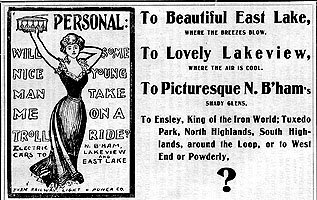 The streetcar brought tremendous changes to the everyday lives of Americans. Beginning in the late 1800s, the streetcar encouraged the growth of suburbs by allowing people to live miles from their work. The streetcar also opened new avenues for amusement that led to the development of Birmingham’s turn-of-the-century lake resorts. More...
Subscribe to:
Posts (Atom)